| cmd | ||
| docs | ||
| internal | ||
| web | ||
| .containerignore | 61 B | |
| .env.example | 359 B | |
| .gitignore | 63 B | |
| .golangci.yml | 963 B | |
| .hearthforge-ci.toml | 1.4 KB | |
| assets.go | 275 B | |
| compose.yml | 834 B | |
| Containerfile | 755 B | |
| go.mod | 592 B | |
| go.sum | 4.4 KB | |
| LICENSE.md | 33.5 KB | |
| README.md | 6.6 KB |
PhysioBase
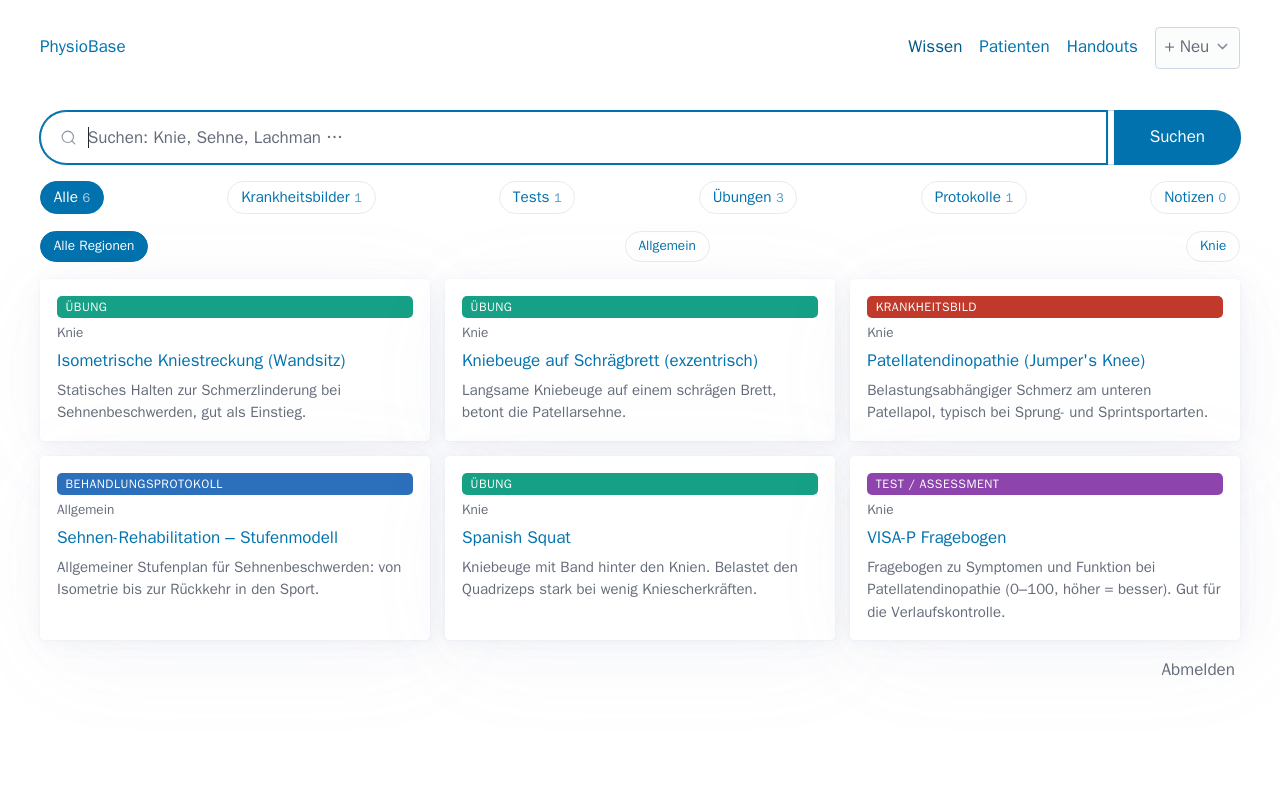
A self-hosted knowledge base and documentation tool for physiotherapy. It keeps conditions, tests, exercises and treatment protocols in one searchable place, links them to patients and their assessments (Befunde), and prints exercise handouts and assessment reports.
One static Go binary, one SQLite file, server-rendered pages. The interface is in German. JavaScript is only used for marking the body chart and a few conveniences; everything else works without it.
Features
- Knowledge base: conditions, tests/assessments, exercises, treatment protocols and notes. Markdown content, tags, body regions, images, videos and PDFs, source references, and links between entries.
- Search: full text (SQLite FTS5) with prefix matching and diacritics
folding:
kniefinds Kniegelenk,ubungfinds Übung. - Exercise handouts: pick exercises, set dosage and a personal note, reorder, copy as a template, print or save as PDF (A4 print view).
- Patients: assessments, treatment log, linked knowledge entries and home programmes on one page.
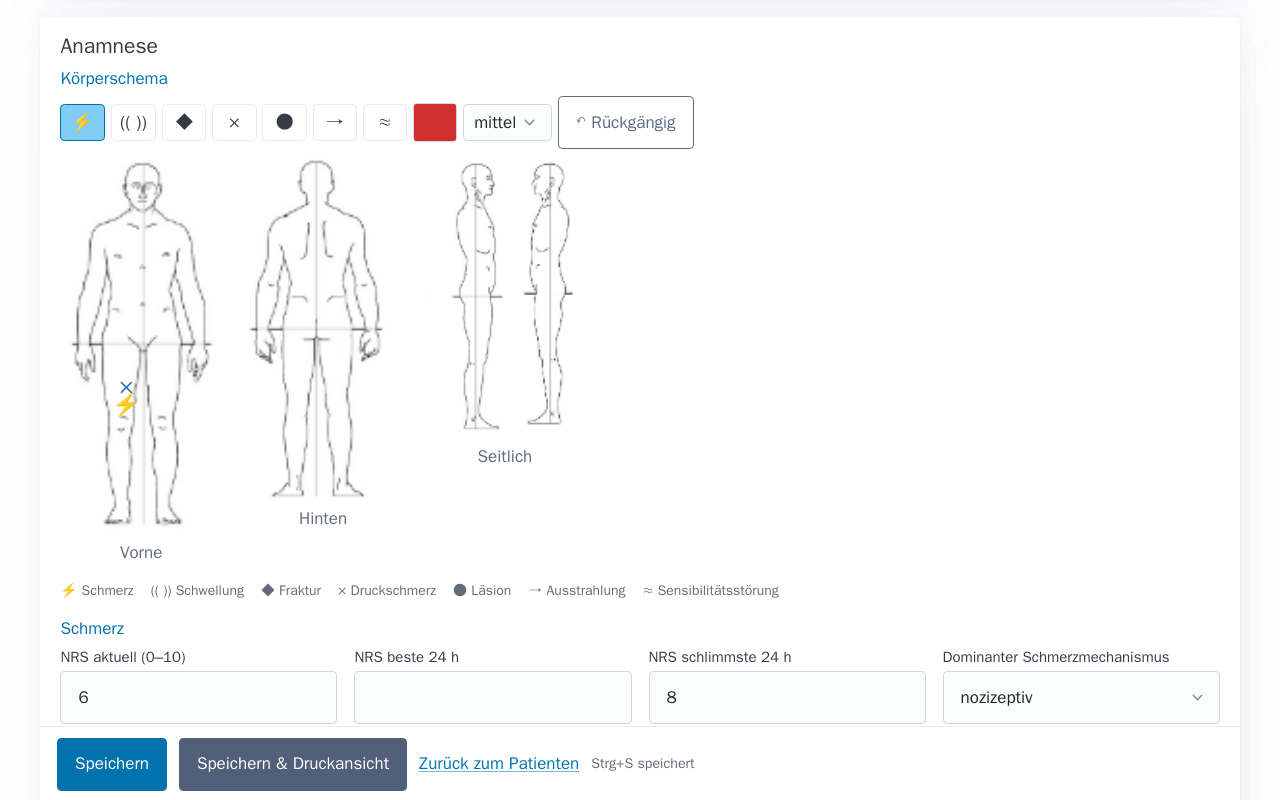
- Assessment form (Befund): ICF-oriented and evidence-based, including red/yellow flag screening, NRS and pain mechanism, a body chart with symbol stamps, ROM/strength/girth tables, special tests, PROMs and performance tests, PSFS, differential diagnoses, and plan rationale. Specialty sections (orthopaedics, neurology, internal medicine, gynaecology/obstetrics, urology, paediatrics) open only when they contain data.
- Re-assessment and comparison: start a new assessment as a copy of the
last one. Compare any two assessments; table rows are matched (for example
joint and movement) and numeric changes are shown as Δ, including
Neutral-Null notation (
0-5-100→0-0-125gives-5 / +25). - Print view: only filled fields, body chart with legend, optional treatment log, signature lines.
- Import: JSON exports of the previous standalone assessment page
(
Befund_*.json) and of PhysioBase itself. - Backups: consistent SQLite snapshots (
VACUUM INTO) at start and every 24 hours, with a configurable number of kept copies.
Stack
- Go standard library, including the
net/httprouter andhtml/template - SQLite through modernc.org/sqlite (pure Go, no cgo), FTS5 for search
- goldmark for Markdown (raw HTML disabled)
- bcrypt from
golang.org/x/crypto - Pico CSS, vendored; no frontend build step
The form for an assessment is defined once as data in
internal/befund/schema.go. The input form,
print view, comparison and import are all generated from it. A new field added
there appears everywhere.
Running
With the container image:
cp .env.example .env
echo 'your-password' | podman run --rm -i localhost/physiobase hash-password   # after the first build
# paste the hash into .env
podman compose up -d        # or: docker compose up -d
compose.yml builds the image, mounts ./data and publishes port 8080.
From source:
go build -o physiobase ./cmd/physiobase
echo 'your-password' | ./physiobase hash-password
PHYSIOBASE_USERNAME=admin PHYSIOBASE_PASSWORD_HASH='$2a$12$…' ./physiobase
Then open http://localhost:8080. An empty database gets a few sample entries (tagged Beispiel) so the structure is visible. They can be deleted.
Commands
| Command | Purpose |
|---|---|
physiobase |
Start the server |
physiobase hash-password |
Read a password from stdin, print its bcrypt hash |
physiobase healthcheck |
Exit 0 if /healthz answers; used by the container health check |
Configuration
All configuration is through environment variables. Templates and static files are embedded in the binary.
| Variable | Default | Purpose |
|---|---|---|
PHYSIOBASE_USERNAME |
— | Required. Login user |
PHYSIOBASE_PASSWORD_HASH |
— | Required. bcrypt hash of the password |
PHYSIOBASE_PORT |
8080 |
Listen port |
PHYSIOBASE_DATA_DIR |
./data |
Root for everything below |
PHYSIOBASE_DB_PATH |
<data>/physiobase.db |
SQLite database |
PHYSIOBASE_MEDIA_DIR |
<data>/medien |
Uploaded images, videos, PDFs |
PHYSIOBASE_BACKUP_DIR |
<data>/backup |
Daily database backups |
PHYSIOBASE_BACKUP_KEEP |
14 |
Backups to keep; 0 turns them off |
PHYSIOBASE_PRACTICE_NAME |
PhysioBase |
Shown in the header and on printouts |
PHYSIOBASE_BASE_URL |
— | External URL; an https:// value makes cookies Secure and enables HSTS |
PHYSIOBASE_SEED |
1 |
Insert sample entries into an empty database |
PHYSIOBASE_LOG_LEVEL |
info |
debug, info, warn or error |
PHYSIOBASE_LOG_FORMAT |
text |
text or json; logs go to stderr |
The server refuses to start without a username and password hash. There is no mode without login.
Security
- Sessions are signed cookies (expiry plus HMAC). Logging out rotates the signing secret, which ends every session on every device. Changing the password does the same.
- Logins are rate limited: at most two bcrypt checks run at once, and each failed attempt waits a second.
- Strict Content Security Policy: no inline scripts or styles, and
script-src 'self'. - Cross-site POSTs are rejected through Go's
http.CrossOriginProtection. - Uploaded files are only served if they belong to an entry in the database.
Health data: once real patient data is stored, run it behind HTTPS with access limited to people who need it. Encryption at rest is not built in yet; put the data directory on an encrypted volume.
Data and backups
data/
├── physiobase.db        SQLite (WAL mode)
├── medien/              uploads
└── backup/              physiobase-YYYY-MM-DD_HHMMSS.db
Do not copy physiobase.db while the server runs. In WAL mode, recent writes can
still be in physiobase.db-wal. Use the files in backup/; each one is a
complete, consistent database.
Restore: stop the server, copy a backup to physiobase.db, delete
physiobase.db-wal and physiobase.db-shm, start again.
Development
go test -race ./...
golangci-lint run ./...
gofumpt -l -extra .
The same checks, plus go mod tidy and govulncheck, run in CI on every push
(see .hearthforge-ci.toml).
License
GNU Affero General Public License v3.0. If you run a modified version as a network service, its users are entitled to the source code.
Bundled third-party files keep their own licenses:
Pico CSS (web/static/pico.min.css) is MIT-licensed.